AI value is won in the workflow, not in the model
Enterprise AI advantage will not be won by the smartest model. Nor will it be won by having the best integration connectors.
Architectures are evolving fast, but what is clear is that many teams are misallocating their engineering capital because they cannot tell the difference between differentiation, control, and pure plumbing.
If you want to move beyond expensive AI science experiments and build a defensible operational moat, you have to ruthlessly map your architecture to where the value actually sits.
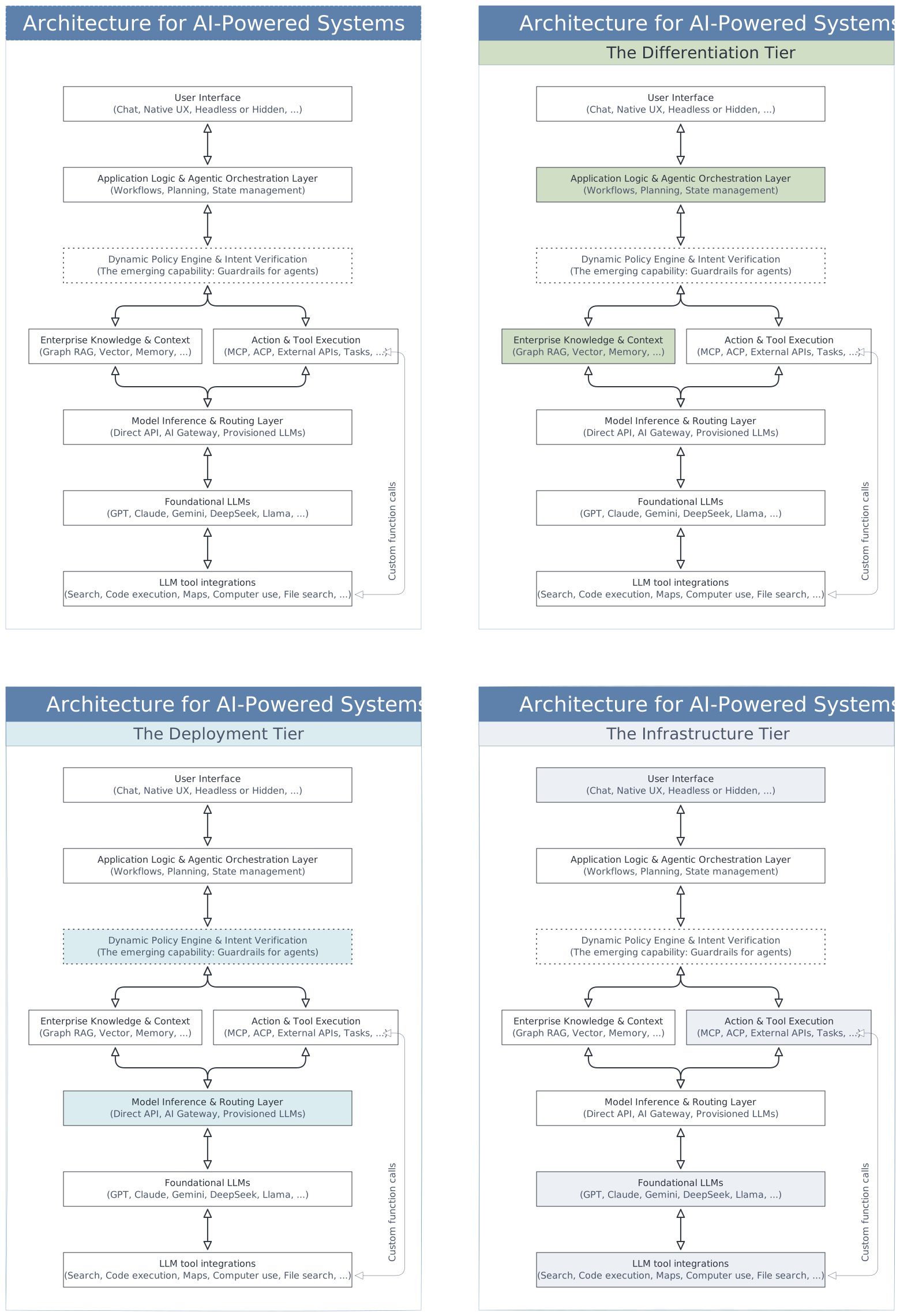
1. The Infrastructure Tier: Zero strategic advantage
This is the foundation layer. Ask a developer who is using AI code assistants and they will likely have strong views on which particular model they like to use. But the reality is that it matters less than most people think (it is more about familiarity) and for certain it will matter less in the future as model capabilities converge. There is technical leverage in the infrastructure tier and it matters for speed of deployment. I like how Google Gemini provides a rich, higher-level API with strong tool integrations, moving more of my orchestration and integration layer to their platforms. But everyone can rent the same capability, the same MCP integrations, and, in most cases, buy the same user interfaces.
Many AI roadmaps are currently obsessed with two things: enabling access to the frontier models, whether the latest or the easiest to write governance policies for, and writing connectors to plug them into internal databases or tools.
This is pure plumbing. Between aggressive model feature-wars and open-source standardization, the baseline tech stack is a commodity utility. Even the Model Context Protocol (MCP), while a brilliant, pragmatic standard, is just a upgraded USB connector. Connecting a model to enterprise data is a baseline requirement for survival, not a competitive edge. If your competitor can rent the same model and install the same socket, your technology moat is exactly zero.
The user interface layer does provide a small opportunity for differentiation, but most organizations are not pushing that hard but instead relying on vendor-provided applications, which brings its own problems as I discussed in The AI Dependency Trap.
This doesn’t mean you shouldn’t do the plumbing: you absolutely should, and you should do it well, and you should do it now. Just don’t kid yourself that this is where you build strategic value.
2. The Deployment Tier: Your licence to operate
This is the control layer. Enterprises will decide if they access AI models direct through the API to the vendor or inference engine, through a gateway, or through provisioned capacity such as AWS Bedrock Provisioned Throughput or Azure Foundry PTU. There is important technical value to be gained here, especially in agility to change and cost to support. In an agentic AI world identity and access management is a particularly hard problem that is well beyond what current solutions provide and is largely unsolved. The dynamic policy engines that I briefly mentioned in the previous post are still emerging. Also included in this layer, but not shown in the diagram, is your logging and audit infrastructure.
I regularly see organizations paying for thousands of Microsoft 365 Copilot subscriptions, only for their “governance” teams to block the tool from accessing company files. They are paying for a brain but refusing to give it sight.
If companies are paralyzed by letting a passive assistant read a slide deck, they have zero chance of deploying autonomous, background agents. If you can’t provide access in the walled garden of your M365 subscription, then your governance and tech leadership is broken.
The wider control challenge is much harder. As I wrote in Your AI Governance Was Built for Assistants, Not Agents, legacy IT wrappers that check a user’s ID at login completely fail here. To deploy in an agentic world, you need an active, programmatic gate embedded in the infrastructure to verify the model’s intent before it executes a tool loop, especially when hidden background triggers begin running silent processes outside human vision.
Controls don’t generate value, but they dictate whether you can turn the engine on. And if you can get them right before your competitors then you do have a temporal advantage, though it is unlikely to be sustained.
3. The Differentiation Tier: Your strategic differentiation
Strip away the plumbing and the controls, and you are left with the only two boxes that are uniquely proprietary to your business: Your Knowledge and Your Processes, deployed in unique ways.
- Enterprise Knowledge & Context (The Memory): What your company uniquely knows. Your proprietary data graphs, historical institutional context, and unstructured intellectual property.
- Application Logic & Agentic Orchestration (The Method): How your company uniquely operates, the processes that support your strategic differentiation.
Not all of your processes need to be unique. You might be a business that competes primarily on superior access to capital, entrenched regulatory moats, or classic economic rent-seeking.
But even if you win on asset scale or regulatory positioning, you still have to execute. If your AI strategy relies on generic, out-of-the-box prompts running on standard interfaces, you aren’t automating your edge; you are standardizing your mediocrity. The differentiation happens when your orchestration layer natively encodes the exact, specific procedural nuances that make your firm defensive.
This is also where the smartest vendors innovate. The foundational providers integrate more of the orchestration through reasoning models and advanced tool integrations, with some divergence in how this is architected across vendors. Higher in the value chain, vendors are providing entire specialist stacks for use cases like legal sectors where, again, their key value is in the curated knowledge to provide reliable information and the logic and orchestration that provides the checks and controls.
The Existential Challenge: If a vanilla, off-the-shelf agent running on a base model can replicate your workflow, your process is not a differentiator. It is legacy bureaucracy waiting to be automated out of existence by a leaner competitor.
Lessons from the Engine Room
Our recent work with the Lloyd’s Market Association (LMA) on AI and ML in Actuarial and Risk highlighted a critical market shift. As firms move from early experimentation to early-stage deployment, traditional compliance frameworks are hitting a wall. The overriding takeaway is clear: You cannot govern intelligent systems with static IT checklists. AI governance is fundamentally a process design challenge.
When we work in highly regulated markets—like actuarial reserving—the hard part is never connecting the LLM. That takes an hour. The hard part is embedding the controls directly into the execution path:
- Where does the system sit?
- What proprietary context can it safely access?
- How do we verify intent before it triggers an action?
In a reserving transformation I led for a UK specialist insurer, we mapped out a transition from legacy Excel models to a code-first Python and Snowflake environment for actuarial teams. This was machine learning, the older cousin of AI. The breakthrough wasn’t “smarter math.” It was putting data segmentation logic directly into the actuaries’ hands and using Git-based workflows to make model changes completely transparent and rigorous.
We didn’t just automate a task; we built an immutable, auditable system of controls as code. We codified a unique process to protect unique knowledge.
The Executive Playbook
If you are directing capital for an AI-powered enterprise, your mandate is simple:
- Minimize the plumbing: Rent the models, install the standard MCP sockets, and treat the infrastructure as an interchangeable utility.
- Implement the controls: Build a dynamic policy engine so your risk team gives you the license to deploy.
- Over-index on the value: Put every single dollar of engineering capital into codifying your proprietary knowledge graphs and designing your unique workflow orchestration.
A firm with a moderately smart model deeply embedded in an unassailable, highly specific workflow has the foundations to completely obliterate a competitor with a brilliant model trapped in an inbox.
About me: I help you turn complex data into clear decisions and commercial outcomes. I don’t just design architecture or manage governance; I build the engines that turbo-charge innovation and P&L growth. When most data leaders play defence, I play offence, bringing a CERN physicist’s first-principles edge to your competitive strategy.
To understand in detail how we implement the “Memory” layer of this stack, I built Vault Intelligence, an open-source framework for Obsidian dedicated to local knowledge systems. Moving beyond basic semantic search, it relies on two core architectural innovations:
- Graph maintenance: The Gardener is an automated, human-in-the-loop process that prunes and maintains a structural knowledge graph of your institutional or personal knowledge to help create a carefully curated repository.
- Context maximization: The Shadow Graph is an orchestration technique that optimizes and maximizes the fill of the model’s context window to feed the LLM a hyper-dense, hyper-relevant stream of institutional memory.
This works up to perhaps tens of thousands of documents. Next step is infinite scalability: not a conceptually difficult step but I always find that physical implementation brings out challenges that I would not otherwise consider.
Are your AI projects currently trapped in prototyping hell or governance paralysis, or are you successfully embedding them into your core workflows? Let me know in the comments. 👇
Follow me on LinkedIn for more insights.